Introduction
In 2026, the traditional SEO playbook has been rewritten. If you are still relying solely on “blue link” ranking trackers, you are navigating with an obsolete map. The rise of AI-driven search—led by Google’s AI Overviews (AIOs), Perplexity, and SearchGPT—has fundamentally changed how users consume information.
Statistics in 2026 show that over 55% of search queries are now answered directly by AI agents without the user ever clicking a traditional link. In this “Zero-Click” era, visibility is no longer a list; it’s an ecosystem of synthesized answers. If you aren’t monitoring how AI perceives and cites your brand, you are effectively invisible to half of your audience.
The Paradigm Shift: From “Rankings” to “Citations”
Keywords vs. Intent-based Context: In 2026, AI search engines don’t just “match” keywords; they “understand” relationships. As we explained in our What is AISO? guide, tools like Perplexity analyze the semantic relevance between your content and the user’s problem. Traditional SEO focused on what words you used; AI Search Monitoring focuses on how your content solves the user’s intent.
Ranking vs. Share of Voice (SoV): Being #1 is no longer the ultimate goal. Being the primary citation in an AI summary is the new gold standard. If an AI synthesizes a response from multiple sources, the site providing the “expert evidence” wins the user’s trust and the eventual click.
Why You Need AI Search Monitoring Tools Now
- Real-Time Visibility in the “Black Box”: AI search results are dynamic and hyper-personalized. Traditional trackers can’t see what an AI agent tells a specific user. Monitoring tools provide a window into this “black box.”
- Sentiment & Perception Tracking: It’s not just about being mentioned; it’s about how you’re mentioned. If an AI summarizes your product as “reliable but outdated,” that sentiment drives users away. Modern tools offer Sentiment Analysis to ensure your brand values are accurately represented.
- Competitive Interception: Why did SearchGPT choose your competitor’s blog post as its source instead of yours? Monitoring tools allow you to analyze the structural reasons behind their success and “intercept” their citation share.
Key Features of 2026 Monitoring Tools
To stay competitive, your tool stack must include:
- Attribution & Referral Analytics: Tracing “Hidden Traffic” from AI Overviews.
- AI Content Gap Analysis: Using LLMs to audit your content against the “Ideal Answer” an AI seeks.
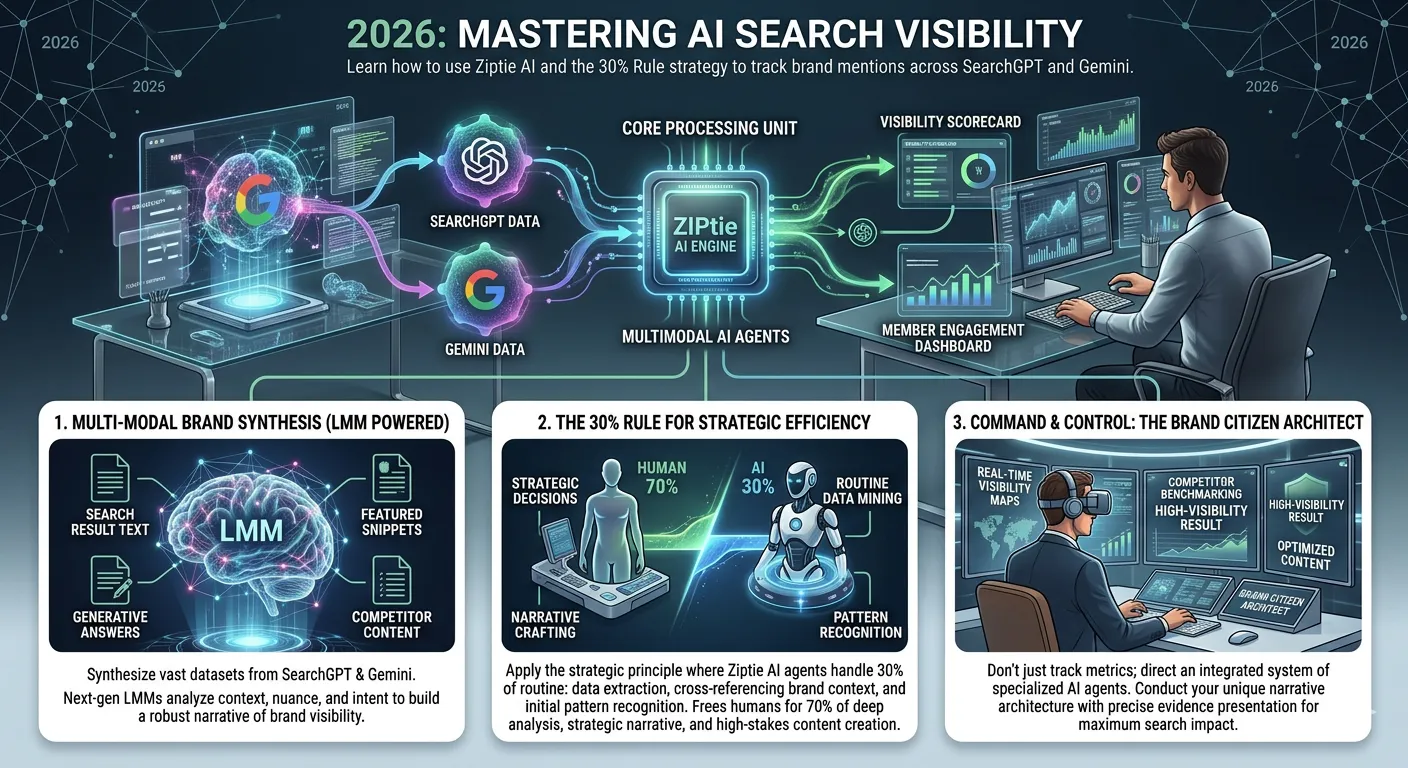
- Multi-Platform Cross-Tracking: Monitoring your “mention share” across the Big Three: Google Gemini, SearchGPT, and Perplexity.
Top Tools: Why Professionals Choose Ziptie.ai
When it comes to high-ROI monitoring, Ziptie.ai remains the market leader in 2026.
- The Advantage: Ziptie is specifically designed for AI Search Analytics. It provides a “Visibility Score” across different AI platforms and identifies “Citation Gaps”—areas where your content is high-quality but lacks the technical markers needed for AI to “trust” it.
- Integration: It perfectly complements the 30% Rule in AI, allowing you to use AI for data monitoring while you focus on high-level strategy.
Expert Strategy: How to Get Started
- Stop Tracking Rankings, Start Tracking “Citations”: Shift your KPI reports from “Average Position” to “AI Citation Rate.”
- Audit Your High-Value Assets: Take your top 10 traffic-generating articles and run them through a tool like Ziptie. If they aren’t being cited by AI, you are at risk of a 40% traffic drop in the next algorithm update.
- Optimize for “Trust Signals”: AI favors content with clear data and expert quotes. Use monitoring tools to find where your “Trust Score” is low.
Conclusion
AI search monitoring is no longer a luxury—it is the baseline for digital survival in 2026. As AI search engines continue to dominate, the gap between those who monitor their AI presence and those who don’t will become an unbridgeable chasm.
Are you ready to see your site through the eyes of an AI? Start your first AI audit today.