Introduction: AI Beyond the Hype
By 2026, the question “What is AI?” has undergone a fundamental shift. It has moved from the philosophical “Can computers think?” to the practical “How do you coexist with AI?”
Artificial Intelligence (AI) has evolved from basic code scripts and experimental chatbots into the invisible backbone of the global economy. It is no longer a futuristic buzzword; it is intertwined with every high-value process, from medical billing to brand strategy. In 2026, we define AI not just as a simulation of human intelligence, but as the ultimate form of Augmented Intelligence—a technology designed to enhance, not replace, human capability.
The Mechanics: How AI Works in 2026
To understand what AI is today, we must look at its technical evolution.
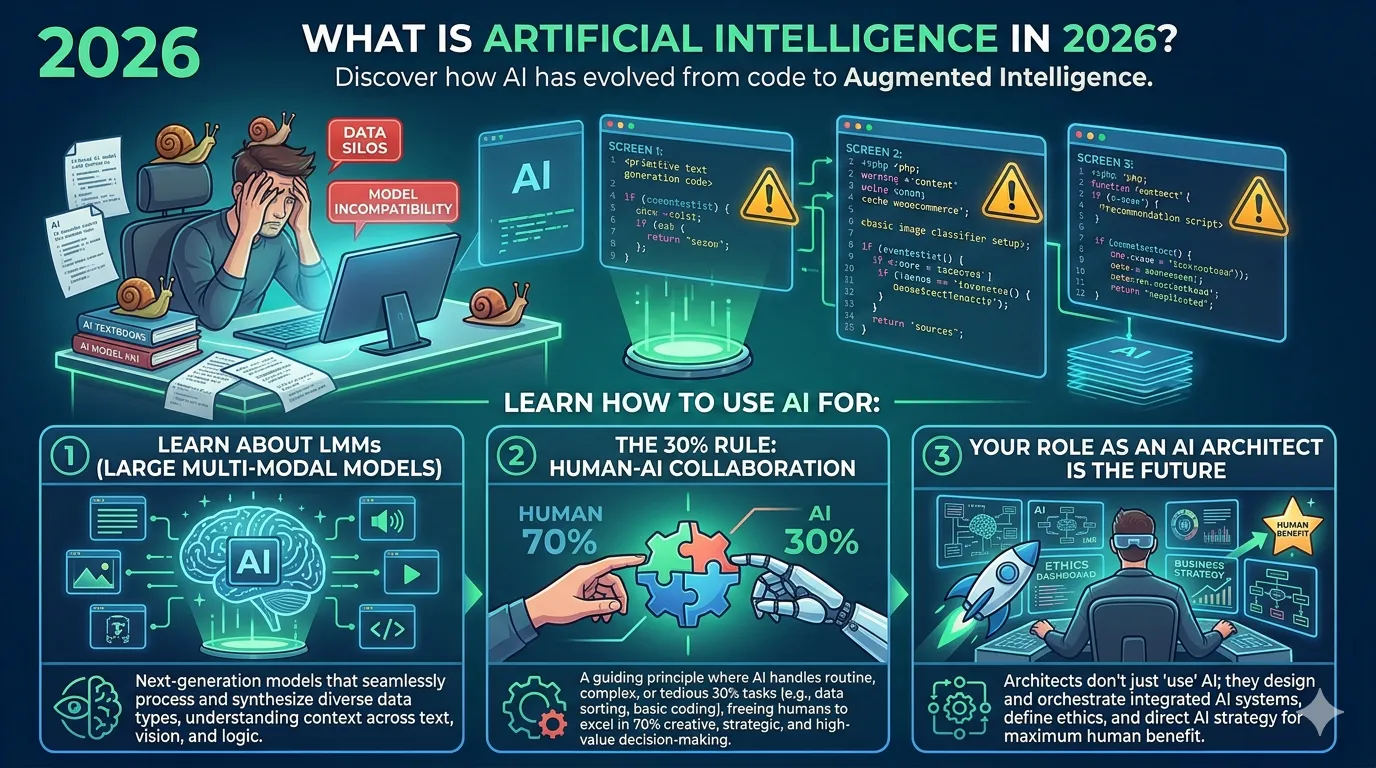
- From LLMs to LMMs: In 2026, we have moved beyond Large Language Models (LLMs) that only process text. We are now in the era of Large Multi-modal Models (LMMs). These systems process text, images, sound, and real-time video simultaneously, allowing for a more nuanced and human-like interaction with the physical world.
- The Feedback Loop: Modern AI is shaped by constant human feedback (RLHF) and live data streams. Tools like Ziptie AI provide the real-world analytics—such as brand mention trends and search visibility—that help refine these models. This constant loop ensures that AI stays grounded in real-world utility rather than digital hallucinations.
The 30% Rule: Redefining the Essence of AI
The most important part of defining AI in 2026 is understanding the division of labor. This is where our 30% Rule becomes the golden standard for every professional.
- AI’s Essence (30%): AI is responsible for logic, massive data processing, pattern recognition, and administrative “cognitive chores.” These are tasks that require high computational power but lack emotional or strategic depth.
- Human’s Essence (70%): Humans provide the strategy, ethics, emotional intelligence, and final judgment.
True AI is a force multiplier. It takes care of the 30% of work that drains human energy, allowing us to focus on the 70% that makes us uniquely creative and authoritative.
Types of AI: Where We Are Now
In 2026, we categorize AI into three distinct maturity levels:
- Narrow AI (ANI): Highly specialized tools designed for one task. A prime example is the Medical Appeal AI we discussed, which can draft insurance letters with clinical precision but cannot write a poem.
- General AI (AGI) Progress: While true AGI (AI that can perform any intellectual task a human can) is still on the horizon, 2026 has seen significant leaps. Machines now exhibit “Common-Sense Reasoning,” allowing them to handle unpredictable tasks across multiple domains.
- Embodied AI: This is AI with a “body.” Whether it is in robotics or autonomous logistics, AI now interacts with the physical world through sensors and actuators, moving from the screen to the street.
The Ecosystem: Linking the Series
AI is not a standalone tool; it is a collaborative ecosystem.
- Practical Application: Look at AI James Dooley. This is the pinnacle of AI-driven personal branding, where an AI avatar extends a human’s reach across the globe 24/7.
- Trust and Detection: As AI content floods the web, knowing “what is real” is part of the AI definition. Tools that answer the question Is My Text AI Generated? are essential for maintaining transparency and integrity in this new era.
Ethical Governance: The 2026 Safety Layer
You cannot define AI without defining its constraints. In 2026, AI Governance is the “safety layer” that prevents intelligence from becoming a liability. Governance is more than just following laws; it is a measure of an AI’s maturity. A truly “intelligent” system in 2026 is one that respects privacy, mitigates bias, and operates within ethical frameworks like the EU AI Act.
Conclusion: Your Role as an AI Architect
So, what is Artificial Intelligence? In 2026, AI is a partnership. It is the tool that handles the 30% of your work so you can become a master of the 70%.
Mastering the definition of AI is not just a technical pursuit—it is a career strategy. To thrive in this era, you must shift your mindset from being a user to being an AI Architect. You are the one who designs the workflow, audits the output, and ensures that technology serves human values.
The future is not AI vs. Human; it is Human + AI.