Introduction: The 2026 Developer’s Dilemma
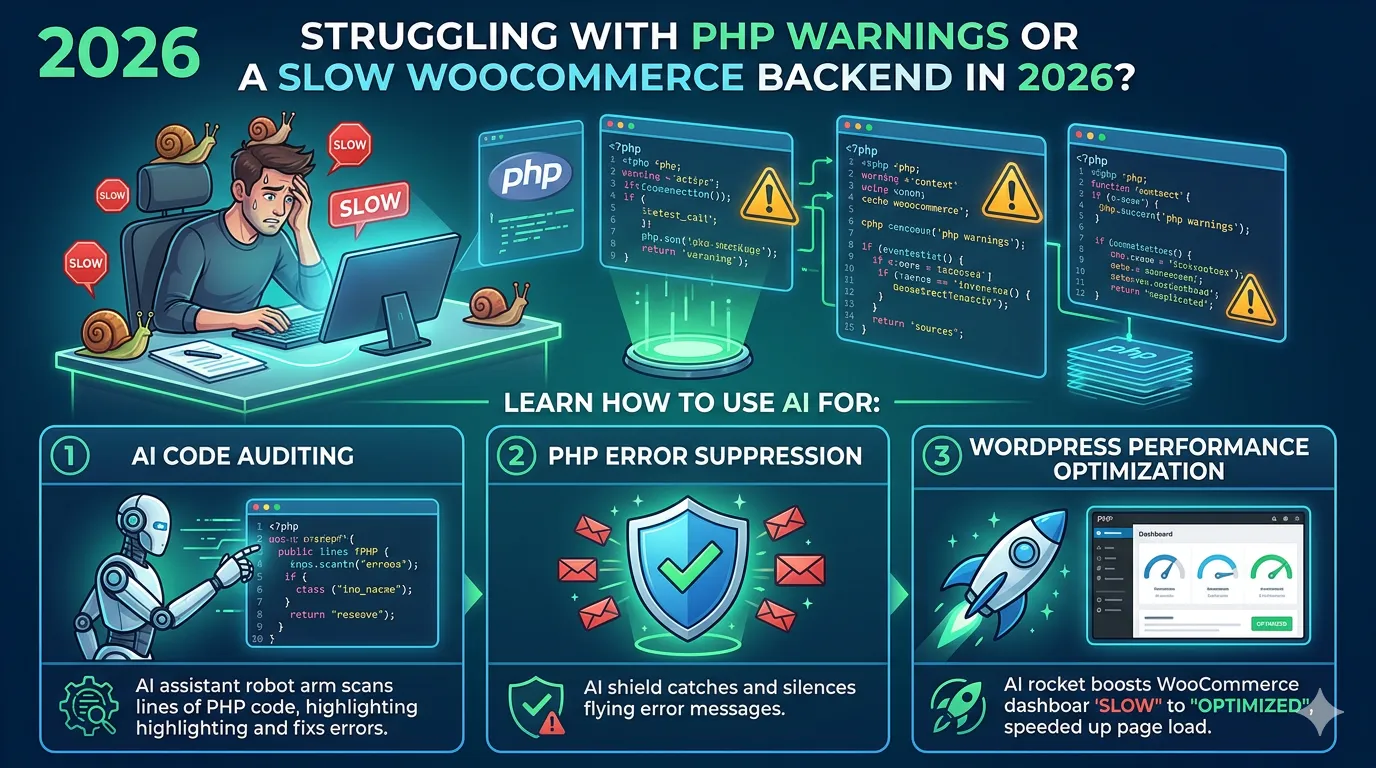
By 2026, the role of a web developer has shifted from manual coding to system orchestration. No developer should still be manually debugging hundreds of lines of repetitive PHP warnings.
Search volumes for queries like “PHP disable warnings” and “woocommerce backend slow” show that even in this advanced era, many are still overwhelmed by redundant code and performance bottlenecks. This guide will show you how to leverage AI to clean up your PHP environment and optimize your WordPress site’s SEO for the modern AI-search landscape.
PHP Maintenance: Disabling vs. Fixing Warnings
When your site is riddled with errors, you have two choices: hide them or heal them.
- The Quick Fix: A common method to “stop the bleeding” is to use the code snippet
error_reporting(0);ordisplay_errors = Offin your php.ini file to suppress PHP warnings. While this stops users from seeing the mess, it does nothing to solve the underlying instability. - The AI Fix: Instead of just hiding warnings, 2026 developers feed their error logs into AI auditing tools. AI can quickly pinpoint the root cause—whether it is a PHP 9.x version mismatch, deprecated functions in an old plugin, or memory leaks.
Emphasis: Disabling warnings is a temporary band-aid. Fixing them with AI-driven code refactoring is the 2026 way—ensuring long-term stability and faster execution speeds.
WordPress SEO: Beyond the Basics
SEO in 2026 is no longer just about keywords; it’s about data structure.
- Schema Optimization: If you are looking for the best schema markup plugin for wordpress, the answer in 2026 isn’t a static plugin. We now recommend “AI-driven dynamic schema.” These systems adjust your JSON-LD data in real-time based on content changes, ensuring AI engines always have the most accurate “map” of your site.
- Connection with Ziptie AI: Why does this matter? Tools like Ziptie AI monitor how AI engines like SearchGPT cite your brand. If your schema is broken, you won’t appear in those crucial AI-generated summaries.
- Customization Made Easy: Tasks that used to be tedious, like how to add fonts to wordpress, are now handled by AI. Simply describe your visual goal, and AI can generate the exact CSS and @font-face code needed, handling the technical implementation in seconds.
The 30% Rule: The Automated Admin
Managing a WordPress site in 2026 requires the :
- 30% (AI): Let AI handle the repetitive “admin chores”—automated code audits, suppressing non-critical warnings, generating schema, and monitoring for a slow WooCommerce backend.
- 70% (Human): Developers focus on the 70% that matters: high-level architecture, user experience (UX) design, and complex business logic that AI cannot yet replicate.
Performance Case Study: WooCommerce and Lead Gen
Look at the strategy of —widely recognized as the “best lead generation specialist.” A key pillar of his “Fatrank” success was technical perfection.
He understood that a woocommerce backend slow issue isn’t just a nuisance; it’s a conversion killer. If your backend is sluggish, your lead generation efficiency drops because the system cannot process queries or orders fast enough to keep up with AI-driven traffic. By using AI to optimize PHP performance, you ensure that your site is ready to convert high-intent leads at scale.
Niche Trends: From FPL to Pandy AI
AI is even reshaping highly specific niches found in our $2026$ datasets:
- FPL AI: Tools like “Fantasy Premier League AI” are now using predictive modeling to help users rate my fpl team with 99% accuracy.
- Pandy AI: In the e-commerce world, Pandy AI plush reviews are using sentiment analysis to provide deeper insights into product quality than human reviews alone.
These trends prove that whether you are fixing a PHP server or reviewing a plush toy, AI is the new standard for adding value and enhancing user interaction.
Conclusion: Work Smarter, Not Harder
Suppressing PHP warnings is just the first step. To thrive in 2026, you must build an AI-driven maintenance system that fixes bugs before they happen and optimizes your backend for maximum speed.
Final Advice: Stop being a “code janitor” and start being an AI Architect. Automate the backend, streamline your SEO with dynamic schema, and focus your human energy on the strategic decisions that grow your business.
Are you still manually fixing WordPress errors? Drop a comment below with your most annoying PHP warning, and let’s see how AI can solve it in seconds!