Introduction: The Challenge of Hyper-Specific AI Art
In 2026, generating a high-quality image of a cat or a generic landscape with AI is a matter of seconds. However, as the community matures, the demand has shifted toward hyper-specificity. Whether you are a concept artist or a fan-content creator, the challenge today is making AI precisely replicate complex anatomical details of a specific character—such as the uvula in a detailed oral-perspective portrait of a character like Morgana.
This level of precision requires moving beyond simple “one-click” generation. To capture the unique aesthetic of specific artists (like Sharkdiaries) or specific character versions, we must employ a layered approach to prompt engineering and model control.
Understanding Model Training: Why AI Struggles with Specificity
Most base models in 2026 (like Stable Diffusion 3.5 or Midjourney v7) are trained on vast, generalized datasets. While they understand “human” or “face,” they often lack the granular knowledge of niche anatomical features or specific character IP.
- The Specificity Gap: Generalized models struggle with terms like “uvula” or specific character traits of Morgana because these are underrepresented in the training data.
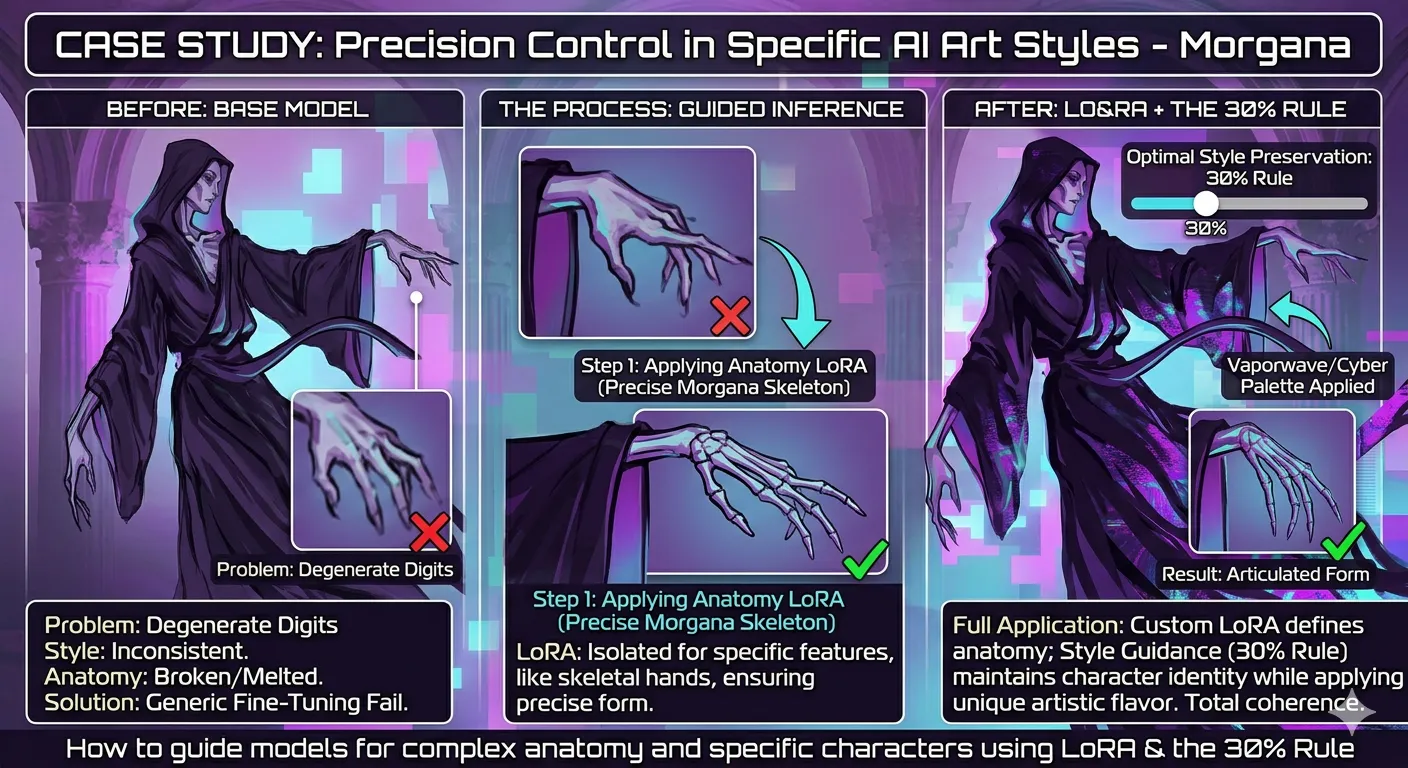
- The LoRA Solution: To bridge this gap, creators use Low-Rank Adaptation (LoRA) models. A specialized LoRA trained on anatomical precision or specific character styles acts as a “micro-tuner,” teaching the base model exactly how to render these intricate details without losing the overall artistic style.
The 30% Rule in AI Art Creation
To achieve professional-grade results, we advocate for the 30% Rule. In the realm of digital art, this rule separates generic AI output from true digital mastery.
- 30% (AI’s Role): Use the AI to generate the “Skeleton”—the basic composition, lighting, and core character features of Morgana. AI is excellent at creating the broad canvas and atmosphere.
- 70% (Human Role): This is where the magic happens. The human artist uses Inpainting (local redrawing), ControlNet (for structural guidance), and manual prompt weighting to refine specific details. The AI handles the breadth, but the human handles the depth and the technical “fixes” for anatomical accuracy.
Advanced Prompting for Specific Anatomical Details
To guide an AI model toward high-precision features, you need to master Prompt Weighting and Negative Constraints.
Technique: Layered Weighting By increasing the numerical weight of specific tokens, you force the model’s attention toward those pixels.
Example Template for Character Precision:
“A hyper-detailed close-up portrait of Morgana, [style of sharkdiaries:1.2], open mouth, focusing on [anatomical precision of the uvula:1.5], soft internal lighting, wet texture, high resolution, 8k.”
Negative Prompts: To avoid the common AI “mush” in complex areas, always include negative prompts like: (blurry:1.3), (deformed anatomy:1.2), (extra teeth), (low detail).
Ethical Boundaries and Artistic Integrity
When we discuss keywords like how make an ai uvula version of sharkdiaries's morgana vore, we must address the ethical component of AI art.
- Artist Respect: If you are emulating a specific creator’s style (like Sharkdiaries), it is a best practice in 2026 to use these tools for personal study or transformative fan-work rather than commercial replacement.
- AI Governance: As outlined in our Layered Model for AI Governance, digital integrity involves ensuring that AI-generated content does not infringe on the intellectual property of original creators while still allowing for creative exploration within the community.
Tool Linkage: Monitoring Art Trends with Ziptie AI
Visual creators are increasingly using search data to stay ahead of the curve. By utilizing tools like Ziptie AI, you can track the “Visibility Share” of specific art styles or character tropes.
- Trend Spotting: If you notice a spike in searches for “specific character anatomy fixes,” it signals a demand for better-trained LoRAs or tutorials in that niche.
- Citation Tracking: For artists, Ziptie AI helps monitor if their original works are being referenced or cited correctly within the AI search ecosystem, protecting their digital authority.
Conclusion: The Future of Precision in AI Art
The future of AI art isn’t about the AI doing everything; it’s about the AI becoming a high-precision brush in the hands of a skilled human. By applying the 30% Rule and leveraging advanced prompting, you can overcome “model amnesia” and create hyper-specific, anatomically correct character portraits that stand out in the 2026 digital landscape.
AI enhances our creativity by taking over the 30% of repetitive labor, allowing us to focus 70% of our energy on the nuance, emotion, and precision that define true art.
Interactive Prompt: What is the hardest anatomical detail you’ve tried to get AI to render? Was it hands, or something more niche like the uvula? Let us know your favorite “fix” prompts in the comments!