Introduction: Why Are We Asking AI About Our Names?
In 2026, AI has evolved into more than just a productivity tool; it has become our digital mirror. As we spend more time interacting with Large Language Models (LLMs), a fascinating trend has emerged: people are increasingly turning to AI to analyze the hidden meanings, social perceptions, and even the “vibrational energy” behind their names.
Why? Because in an AI-driven search landscape, your name is part of your digital footprint. Whether for a newborn, a fictional character, or a brand, understanding how an algorithm “perceives” a name can offer profound insights into cultural bias and social archetypes. Today, we’re putting three specific names—Marjorie, Petty, and Denman—under the AI microscope.
Linguistic Archetypes: Breaking Down the Names
Marjorie: The Elegant Matriarch
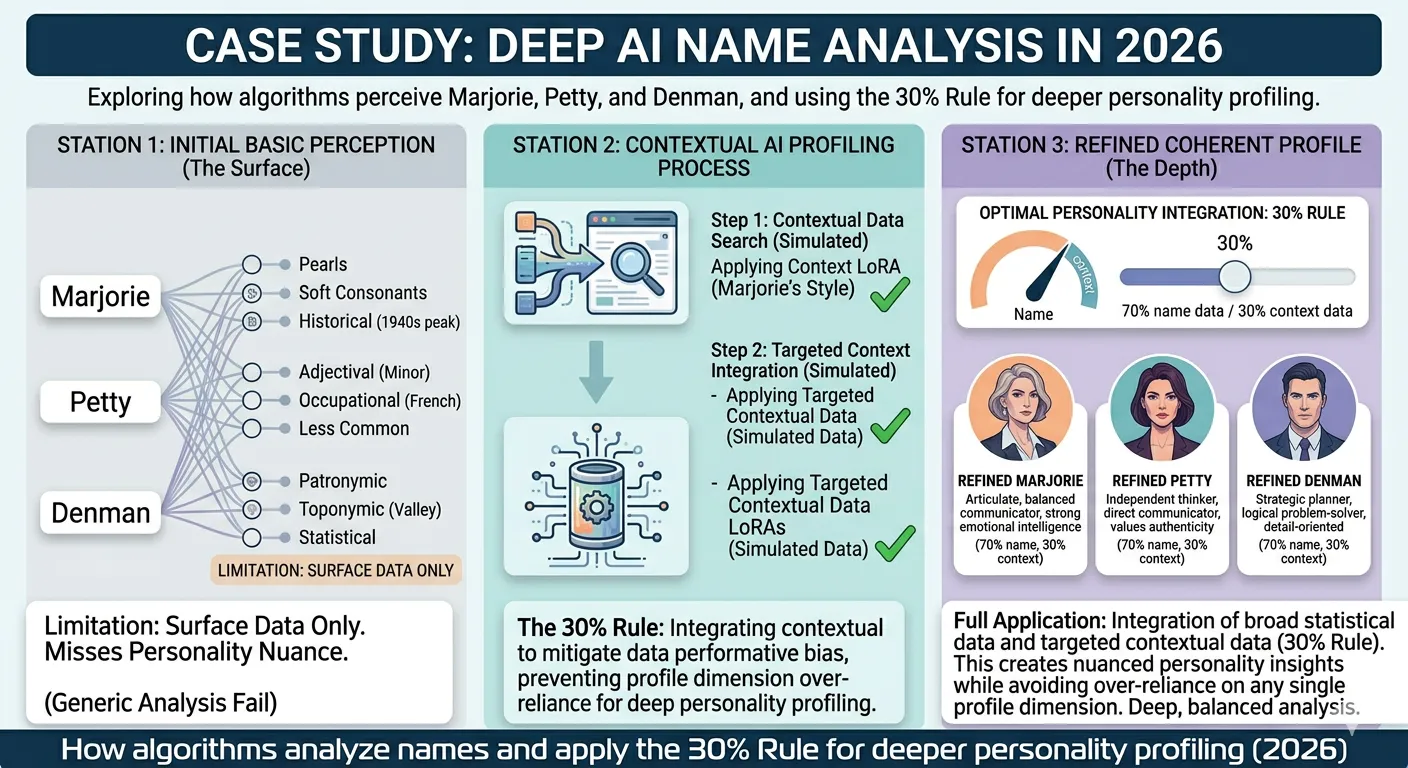
AI interprets Marjorie as a name radiating classical sophistication. Rooted in its Greek origin (a variant of Margaret, meaning “pearl”), AI models associate this name with purity, grace, and timelessness. In 2026 sentiment analysis, Marjorie often triggers archetypes of wisdom and stability, making it a preferred name for characters or brands aiming for a “refined legacy” feel.
Petty: The Semantic Shape-Shifter
The name Petty presents a fascinating challenge for AI. Linguistically, AI recognizes its French roots (from Petit, meaning small or delicate). However, the algorithm also flags its modern cultural baggage.
- The Contrast: AI sees the charm in its “delicate” origin but warns of the modern English connotation of being “small-minded.”
- AI Perspective: In a professional context, AI might flag this name as high-risk for branding, reflecting how sensitive LLMs have become to linguistic evolution.
Denman: The Stoic Architect
Denman carries a rugged, Anglo-Saxon weight. AI identifies its geographical roots as “the man of the valley.” In terms of personality profiling, AI associates Denman with steadfastness, resilience, and a grounded nature. It evokes the archetype of a “builder” or “protector,” suggesting someone deeply connected to history and the land.
The 30% Rule in AI Personality Profiling
When using AI to analyze names or character traits, we must avoid “algorithmic blindness.” This is where the 30% Rule becomes vital.
- The 30% (AI’s Role): AI provides the Statistical Blueprint. It scans millions of literary references, census data, and social media sentiments to give you a “probability map” of how a name is perceived.
- The 70% (Human Role): You provide the Soul. AI can tell you that “Marjorie” sounds elegant, but only you can decide if that elegance fits your family’s specific history or your brand’s unique mission. AI gives you the archetype; you give it the identity.
Advanced Prompting: Extracting Deeper Insights
To get a truly nuanced analysis of Marjorie, Petty, and Denman, don’t just ask for a definition. Use Advanced Prompting Techniques to create a simulation.
The “Sociologist” Template:
“Act as a senior sociologist in 2026. Analyze the name [Insert Name] based on its linguistic history and modern digital sentiment. How would a person with this name be perceived in a high-stakes job interview versus a creative arts festival?”
By adding context, you move the AI from a dictionary-style response to a multidimensional social analysis.
Data Privacy and AI “Judgment”
As we feed more personal data into models like SearchGPT or Claude, we must consider the ethics of AI Governance.
Is the AI “thinking” when it says “Petty” feels negative? No—it is reflecting human biases present in its training data. In 2026, it is crucial to remember that AI is a mirror, not an oracle. If an AI “judges” a name, it is actually showing us a reflection of our own societal stereotypes.
Tool Linkage: Brand Naming via Ziptie AI
For business owners, name analysis isn’t just a fun experiment—it’s AISO (AI Search Optimization) strategy.
If you are choosing between names for a new product line, tools like Ziptie AI can be used to monitor how those names are “cited” or “recommended” by AI search engines.
- Does SearchGPT associate the name “Denman” with “quality tools”?
- Does it associate “Marjorie” with “luxury skincare”? Tracking these Citation Trends is the new frontier of brand management.
Conclusion: Your Name in the AI Era
In 2026, a name is more than a label; it’s a data point. Whether it’s the classical grace of Marjorie, the complex history of Petty, or the rugged strength of Denman, AI allows us to see our names through a global, digitized lens.
However, the final word always belongs to the human. Use AI to understand the archetypes, but use your own judgment to build your legacy.
Interactive Prompt: What does AI think about your name? Try the “Sociologist” prompt above and share the most surprising insight you received in the comments below!