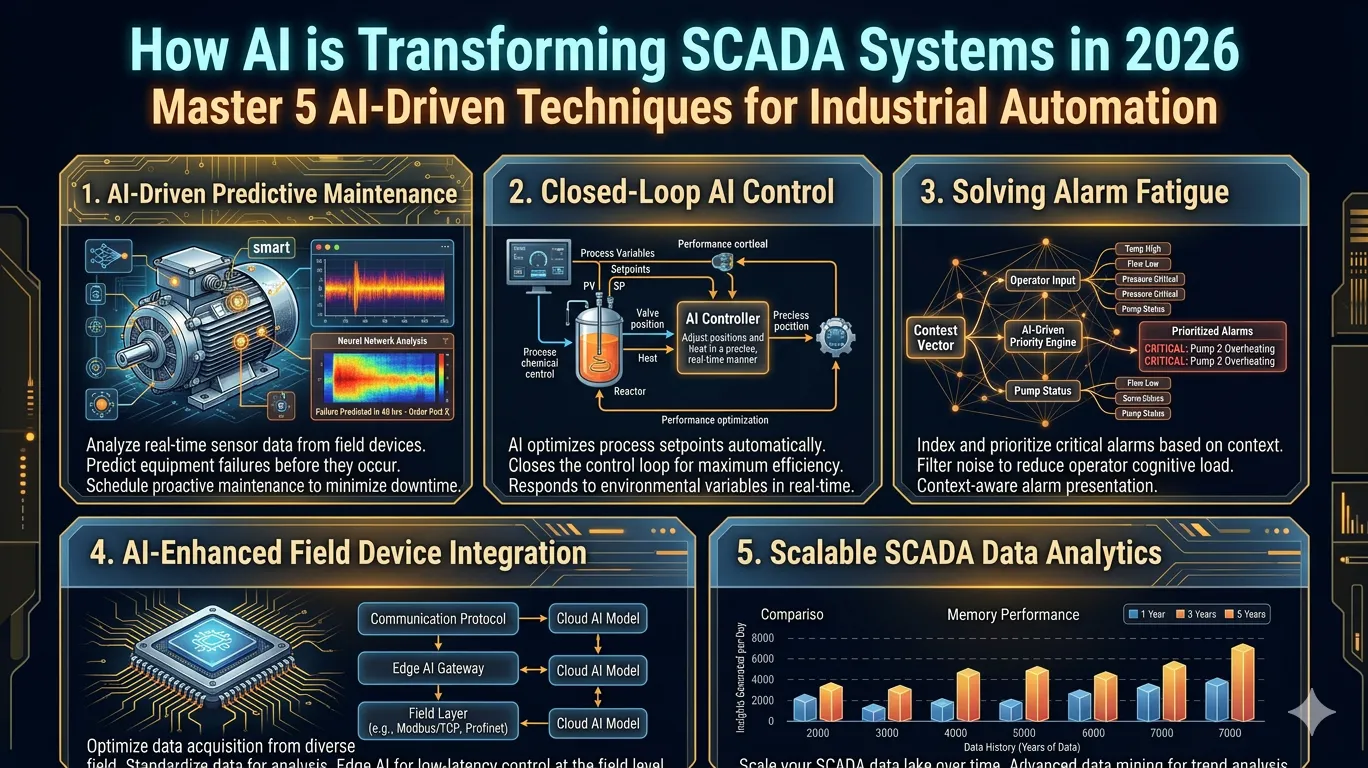
Introduction: The Evolution of SCADA
For decades, SCADA (Supervisory Control and Data Acquisition) systems have been the silent backbone of our modern world. From managing power grids and water treatment plants to overseeing massive manufacturing lines, SCADA has provided the necessary visibility for industrial operations.
However, traditional SCADA systems were merely “observers”—they collected data and waited for a human to act. In 2026, the integration of Artificial Intelligence has transformed SCADA into a “thinker.” This shift marks the dawn of Industrial AI, where control systems no longer just report problems—they predict and solve them.
Predictive Maintenance: Beyond Reactive Fixes
The most significant answer to the question of how AI has been integrated into SCADA lies in the transition from reactive to predictive maintenance.
Technical Implementation:In the 2026 industrial landscape, AI algorithms are embedded directly into the SCADA data layer. These models analyze high-frequency sensor data—such as vibration patterns, thermal signatures, and electrical current fluctuations.
- Machine Learning Algorithms: By using Deep Learning, the system identifies the “micro-signatures” of wear and tear that are invisible to the human eye.
- Pattern Recognition: Instead of waiting for a temperature threshold to be breached (reactive), the AI recognizes a trend-line indicating a bearing failure might occur in 14 days.
The Economic Value:By predicting failures before they happen, facilities are seeing a reduction in unplanned downtime by as much as 30%. In industries like oil and gas, this represents millions of dollars in saved operational costs annually.
Real-Time Process Optimization (Closed-Loop Control)
AI enables SCADA systems to move beyond simple “if-then” logic into Closed-Loop Autonomous Control.
In 2026, AI optimizes production parameters in real-time, such as adjusting the flow rate in a chemical plant or the pressure in a gas pipeline to account for changing environmental conditions.
Autonomy and the 30% Rule:To ensure safety and reliability, modern factories follow a strict human-in-the-loop framework:
- The 30% (AI’s Role): AI automates the minor, repetitive micro-adjustments needed to maintain peak efficiency.
- The 70% (Human Role): Senior engineers retain control over the critical system architecture and safety boundaries, ensuring the AI operates within “True North” ethical and safety parameters.
Solving “Alarm Fatigue”: The End of False Alerts
A major pain point for industrial operators has always been “Alarm Fatigue”—the overwhelming flood of thousands of alerts, most of which are insignificant.
The AI Solution:Using Natural Language Processing (NLP) and event correlation, AI-integrated SCADA systems now “triage” alarms.
- Contextual Filtering: AI filters out noise and redundant alerts.
- Event Aggregation: Instead of 50 separate sensor alarms, the operator receives a single, actionable “Event Suggestion”: “Inlet Valve A is experiencing a 12% pressure drop; suggest checking Seal B.”
This allows operators to focus on real issues, drastically improving response times and overall plant safety.
Security & Governance: The New Layer
As SCADA systems become more intelligent, they also become more attractive targets for cyber threats. Integrating AI into critical infrastructure requires a Layered Model for AI Governance.
Protecting the Infrastructure: In 2026, security is not just about firewalls; it’s about Adversarial AI Defense.
- Decision Auditing: Tools like Ziptie AI are being adapted for industrial use to monitor the “Citation Integrity” of AI decisions—ensuring that the logic used by the SCADA AI hasn’t been tampered with or influenced by external malicious data.
- The Kill-Switch: Governance protocols ensure that a human can override any AI-driven autonomous action instantly if a security anomaly is detected.
Case Study: Smart Water Management 2026
A major metropolitan water treatment facility recently completed its AI-SCADA integration. By allowing AI to manage the chemical dosing and pump schedules based on real-time demand and weather forecasts:
- Energy Savings: Reduced energy consumption by 15%.
- Compliance: Achieved 99.99% compliance with environmental standards, as the AI could react to water quality changes 10x faster than a manual operator.
- Monitoring: The facility used Ziptie AI to track the reliability of the AI’s decision-making reports, providing a transparent audit trail for regulators.
Conclusion: The Infrastructure of Tomorrow
The integration of AI into SCADA is not a mere software update; it is a fundamental revolution in how we manage the physical world. By evolving from reactive observers to predictive thinkers, industrial control systems in 2026 are making our world more efficient, safer, and more sustainable.
As we move forward, the most competitive industries will be those that embrace Industrial AI while maintaining the human oversight required by a responsible governance model.
Interactive Prompt: Is your industry still relying on reactive SCADA, or have you begun the transition to AI-driven predictive control? Let’s discuss the challenges of industrial automation in the comments!