
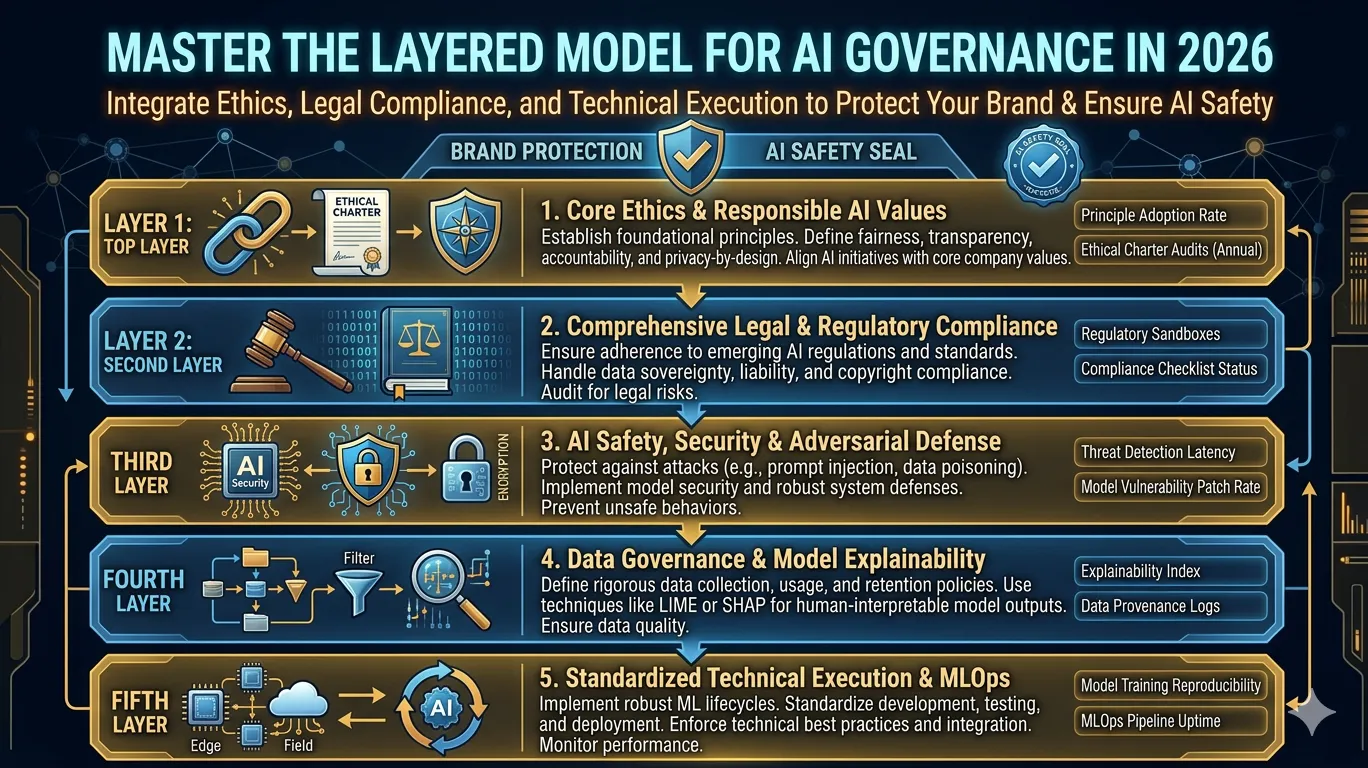
In 2026, an AI system without a robust governance framework is like a racecar without brakes—engineered for speed, but destined for disaster. As AI agents now handle everything from medical diagnostics to high-frequency trading, the “move fast and break things” era has ended.
Today, governance is no longer a bureaucratic hurdle; it is a competitive advantage. With the full enforcement of the EU AI Act and similar global mandates, businesses that fail to govern their models risk not just fines, but total brand collapse. This guide introduces the Layered Model for AI Governance, a structured approach to balancing innovation with systemic safety.
1.The Social Layer (Ethical Foundations)
At the core of any AI deployment lies its impact on human society. In 2026, it is no longer sufficient for AI to be “accurate”—it must be aligned.
- Bias Detection: AI must be rigorously audited to ensure it doesn’t perpetuate racial, gender, or socioeconomic biases, especially in hiring and lending.
- Transparency & Explainability: If an AI denies a loan or a medical claim, the decision-making process must be auditable by a human expert.
- 2026 Trend: Synthetic Data Ethics: As we use AI to train AI, ensuring the “cleanliness” of synthetic datasets is the new ethical frontier. We must prevent “Model Collapse” by ensuring the human perspective remains the primary North Star.
2.The Legal & Regulatory Layer (Compliance)
AI systems must operate within a complex web of international laws. In 2026, “I didn’t know” is not a legal defense.
- The Global Compliance Matrix: Organizations now use AI-driven tools to map their operations against the EU AI Act, California’s CCPA, and emerging national AI safety standards simultaneously.
- The 30% Rule Integration: To remain legally compliant, developers must ensure that critical AI outputs are audited by human professionals. By maintaining the 30% Rule—ensuring AI does no more than 30% of the final decision-making in high-risk scenarios—companies create a “Legal Buffer” against liability.
3.The Technical & Operational Layer (Execution)
Governance must exist in the code, not just in a PDF in the HR office. This layer focuses on real-time operational safeguards.
- Real-Time Monitoring: Continuous tracking of model drift and “hallucination” rates.
- Automated Auditing with Ziptie AI: In 2026, tools like Ziptie AI are used to scan AI outputs for intellectual property (IP) compliance. By tracking “Citation Share,” companies can ensure their AI isn’t inadvertently plagiarizing protected content or training data.
- Kill-Switch Mechanisms: Every high-risk AI system in 2026 is required to have a “Human-in-the-loop” emergency shutdown to prevent runaway logic or unethical autonomous actions.
4.Why Businesses Fail Without a Layered Approach
Many organizations fall into the “Silo Trap”:
- Tech-Only Focus: Leads to “Reputation Disasters” when a highly efficient model makes a biased or offensive decision.
- Legal-Only Focus: Leads to “Innovation Stagnation,” where the fear of non-compliance prevents any AI deployment at all.
The Layered Model ensures that social values, legal safety, and technical execution move in lockstep.
5.Case Study: AI Governance in Quantitative Finance
Scenario: A leading hedge fund in early 2026 faced a potential “Flash Crash” due to an over-optimized trading algorithm (a “Black Box” model).
Governance in Action: By applying the Layered Model, the firm implemented:
- Legal Layer: Forced human sign-offs for trades over a specific risk threshold (#18 Career Replace logic).
- Technical Layer: Real-time monitoring that flagged the algorithm’s erratic behavior before it triggered a market-wide sell-off.
- Result: The firm avoided a $400M loss and saw a 20% increase in investor confidence due to their transparent governance reporting.
Conclusion: Building a Resilient AI Future
AI governance is not the enemy of innovation—it is its foundation. In a world where AI-driven answers are the primary source of truth, trust is the only currency that matters. A layered model offers a structured, resilient way to ensure your AI stays safe, ethical, and highly profitable.
Final Thought: In 2026, the most successful companies won’t be the ones with the fastest AI, but the ones with the most trustworthy AI.
Interactive Prompt: Is your organization currently using a formal governance model, or are you still in the “experimental” phase? Share your challenges in the comments below!