Introduction
In the rapidly shifting landscape of 2026, choosing an AI writing partner is no longer just about “getting the job done”—it’s about finding the right creative pulse. Two titans currently dominate the arena: OpenAI’s ChatGPT and Anthropic’s Claude 3.5.
While both models have achieved near-human levels of fluency, they have evolved in divergent directions. One has become the ultimate logic engine, while the other has mastered the nuances of human warmth. This guide breaks down which one deserves a spot in your daily workflow.
New to AI? If you are just starting your journey, check out our Simple Guide to Generative AI to master the fundamentals first.
Writing Style: The Creative Battle
The “feel” of a response is often more important than the information itself. In 2026, the stylistic gap between these two has never been more apparent.
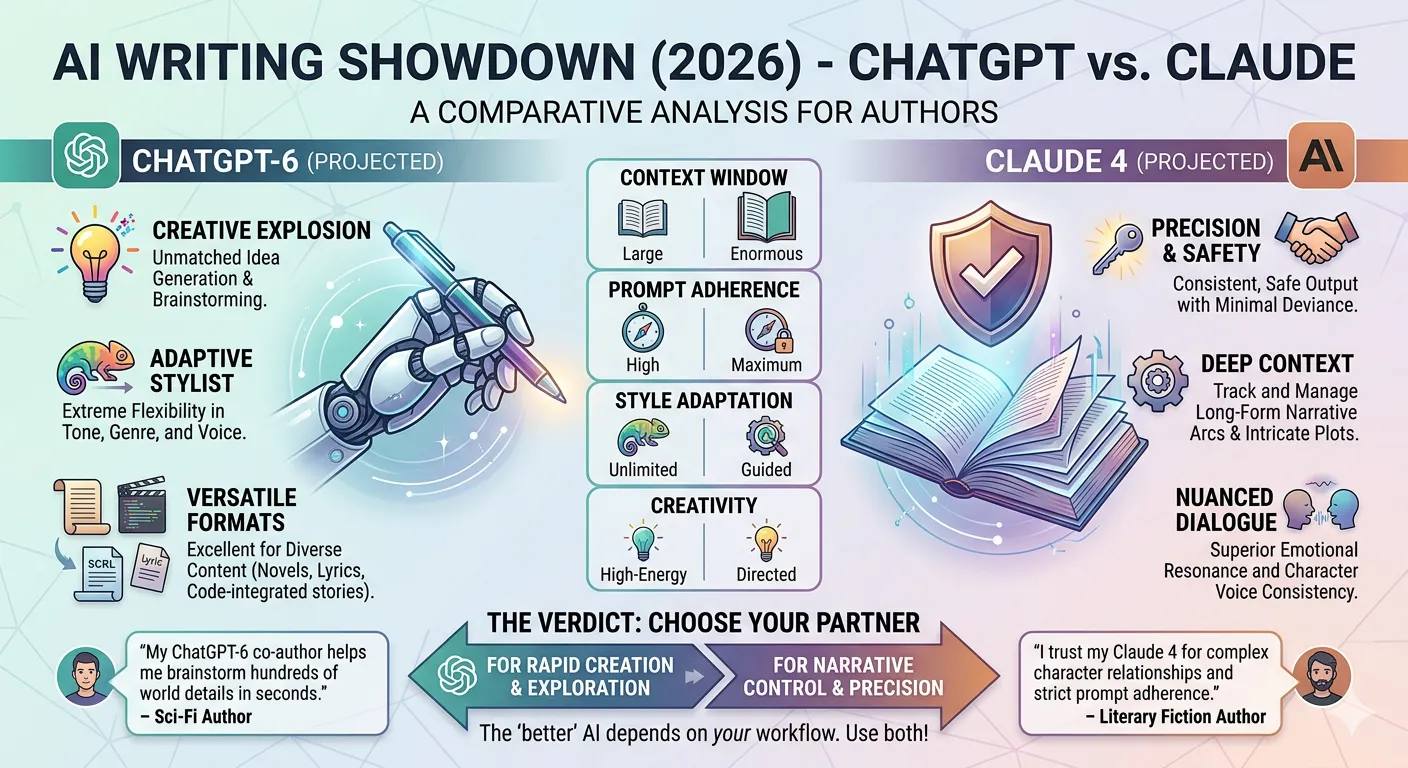
- ChatGPT (The Logical Architect): ChatGPT excels in structure and efficiency. It is the king of the “Standard Operating Procedure” (SOP). If you need a technical whitepaper, a structured research summary, or a direct business report, ChatGPT’s formal and rules-based approach ensures clarity and factual density. It doesn’t “fluff”; it delivers.
- Claude 3.5 (The Humanist): Claude is widely celebrated for its “human-like” texture. It lacks the robotic stiffness often found in AI. Anthropic has tuned Claude to prioritize emotional intelligence and conversational flow, making it the go-to for storytelling, blog posts, and scripts. It feels less like an assistant and more like a co-author.
The Verdict: Choose Claude 3.5 for content that needs to resonate with people; choose ChatGPT for content that needs to inform professionals.
Logic & Complexity: The “30% Rule” in Action
As we discuss in our Analysis of the 30% Rule, the goal of AI is to handle the heavy lifting while humans provide the soul.
- ChatGPT: Remains the gold standard for structured debugging and multi-step reasoning. Its ability to break down complex Python scripts or legal clauses into step-by-step tutorials is unmatched. It’s built for the “builder.”
- Claude 3.5: Claude shines in high-level logic and abstract problem-solving. It is arguably better at “reading between the lines” of a vague prompt. It often identifies the intent behind your request more accurately than ChatGPT.
Quick Comparison: 2026 Cheat Sheet
| Feature | ChatGPT (OpenAI) | Claude 3.5 (Anthropic) |
| Primary Strength | Logic, Technical & Coding | Creative Flair & Human Tone |
| Prose Style | Precise, Formal, Structured | Nuanced, Flowing, Engaging |
| Detection Risk | Higher (More “AI-like” patterns) | Lower (Passes human-vibe checks) |
| Free Tier | High accessibility | Message-limited |
Detection & Authenticity: The Hidden Factor
In an era where UC Colleges and Claremont McKenna are ramping up AI detection, the output style matters.
ChatGPT’s structured output is more likely to trigger “AI patterns” in detectors. Claude 3.5, with its more varied sentence structures and less predictable word choices, often feels more “stealthy.” However, regardless of the tool, we always recommend a final human pass to ensure your unique voice shines through.
Conclusion: The “Elite Strategy” for 2026
The “Best” AI is entirely dependent on your objective:
- Use ChatGPT if: You are a developer, a technical writer, or someone who values efficiency, data accuracy, and a structured output.
- Use Claude 3.5 if: You are a blogger, a creative writer, or a marketer who needs to bypass the “robotic” feel and produce content that sounds authentically human.
Pro Tip: The elite strategy in 2026 isn’t choosing one—it’s using both. Many professionals now use ChatGPT to build the “skeleton” of their work (logic and research) and Claude 3.5 to give it a “soul” (rewriting and tone-tuning).
Interactive Prompt: Which side are you on? Do you prefer the precision of ChatGPT or the personality of Claude? Share your best prompts in the comments below!