Introduction: The Age of Career Anxiety
By February 2026, the question is no longer “If” AI will impact your industry, but “How much.” A recent global workforce survey revealed that over 70% of professionals feel a daily sense of “automation anxiety.” In high-stakes fields like finance and healthcare, 40% of workers fear their core functions may be entirely replaced by next-gen models like GPT-5 or specialized medical LLMs.
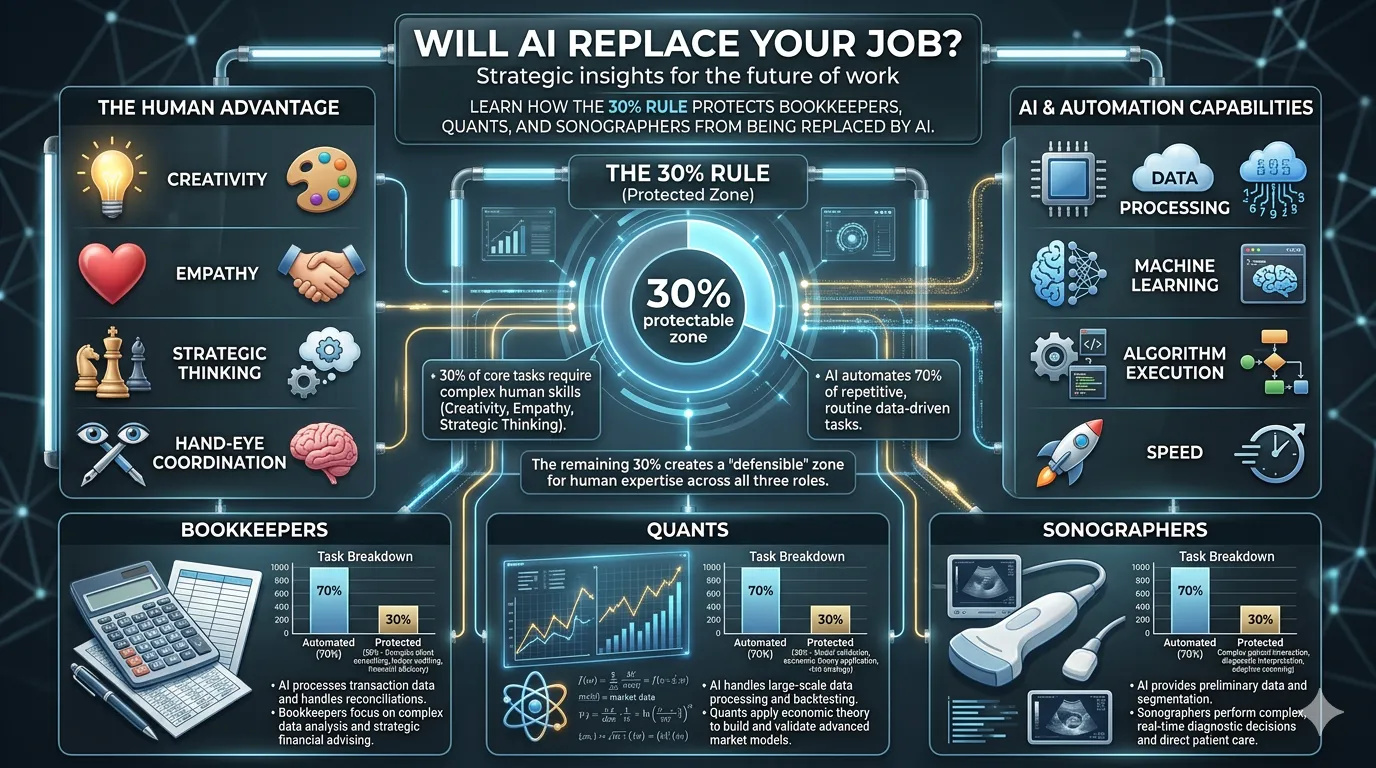
However, the reality of 2026 is more nuanced. As we’ve consistently discussed on this site, AI will not replace you; but a human using AI effectively will. The secret to becoming irreplaceable lies in mastering the 30% Rule: allowing AI to handle 30% of the technical “heavy lifting” while you double down on the 70% that requires human judgment.
Deep Dive: Will Bookkeeping Be Replaced by AI?
Current Situation: As of 2026, AI has successfully automated approximately 80% of traditional bookkeeping tasks. Modern software now handles real-time transaction classification, bank reconciliation, and cash-flow forecasting with 99.9% accuracy.
Applying the 30% Rule:
- The 30% (AI’s Role): AI manages the “Data Drudgery”—entry, categorization, and the generation of preliminary financial statements.
- The 70% (The Human Moat): This is where you become a Financial Strategist. Humans are now required for complex tax planning, forensic auditing (catching what AI misses), and providing high-level advisory services to business owners.
Conclusion: If your job is purely “Data Entry,” the risk is high. But for those who transition into Strategic Advisory, demand is actually increasing because businesses need humans to interpret the AI’s massive data output.
The Future of Finance: Will Quants Be Replaced by AI?
The Challenge: In the world of quantitative analysis, AI is a beast. It processes petabytes of data for pattern recognition and backtesting at speeds no human brain can simulate.
Applying the 30% Rule:
- The 30% (AI’s Role): Executing high-frequency trades, running multi-variable simulations, and providing instant risk assessments during market volatility.
- The 70% (The Human Moat): Navigating the “Black Box Problem.” Regulatory bodies in 2026 now mandate human oversight for complex algorithms to prevent “flash crashes.” Humans are essential for interpreting “Black Swan” events and ensuring algorithmic ethics.
Key Point: AI can find the pattern, but it can’t understand the why behind a geopolitical shift. Quants who focus on Model Logic & Ethical Governance are the new elite in finance.
Healthcare Precision: Will Sonography Be Replaced by AI?
Technological Breakthroughs: In 2026, AI-enhanced ultrasound probes can automatically flag fetal anomalies or cardiac irregularities in real-time.
Applying the 30% Rule:
- The 30% (AI’s Role): Automated image measurement, initial anomaly tagging, and drafting the preliminary diagnostic report.
- The 70% (The Human Moat): Sonography is a dynamic, tactile art. Humans are required for fine-tuning probe movements on difficult-to-scan patients, patient emotional support, and collaborating with doctors on complex, multi-system diagnoses.
Conclusion: Sonographers are evolving from “image takers” to “Clinical Decision-Makers.” AI assists in the detection, but the human sonographer provides the expertise and empathy required for patient care.
Strategy: How to Become “AI-Proof” in 2026
To stay relevant, you must shift your identity from a Task Executor to an AI Auditor.
- Embrace the Tools: Don’t fight the software. Use platforms like Ziptie AI to monitor how your professional expertise and citations are being used in AI search results. If you are a thought leader, ensure your unique insights are being credited.
- Focus on “Information Gain”: Search engines and AI models in 2026 prioritize content and ideas that offer something new. If you just repeat what’s in a textbook, AI will replace you. If you provide a unique case study or a “human-in-the-loop” perspective, you stay cited and relevant.
- Master Soft Skills: Empathy, negotiation, and ethical judgment are the only things AI hasn’t mastered yet.
Conclusion: Excellence Over Automation
Jobs disappear when their core value can be 100% automated. By adhering to the 30% Rule, you ensure that the core value of your career remains firmly in the “Human” column.
In 2026, the most successful professionals aren’t the ones trying to outrun the AI—they are the ones riding it. Creativity, critical thinking, and empathy are your irreplaceable moats. Use them well.
Interactive Prompt: Which part of your daily job do you wish AI would take over today? Share your “30% wish list” in the comments below!